Care Delivery & Innovation
99% of Patients Can Now Find a Stem Cell Donor. So Why Aren't More Getting Transplants?
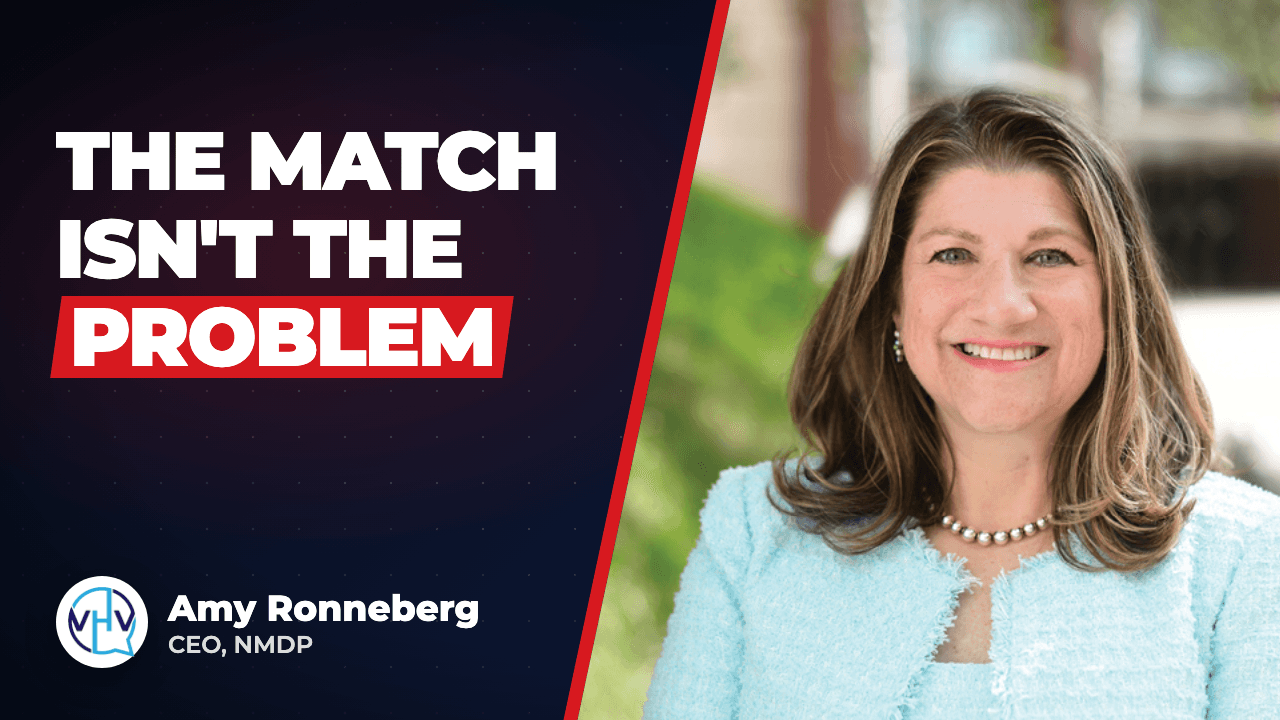
Nearly every adult who needs a stem cell transplant can now find a donor, yet patients still miss out on transplants because of late referrals, insurance gaps and the cost of the caregiver every patient is required to have. Amy Ronneberg, CEO of NMDP, explains where the bottleneck has moved and what it will take to clear it.
Amy Ronneberg has led NMDP, the nonprofit formerly known as Be The Match, since early 2020, weeks before COVID shut borders that half of its donor-to-patient deliveries cross. She joined as CFO in 2013 after an early career as an auditor at Ernst & Young and more than a decade at Capella Education. She tells Anthony and Amar how she was diagnosed with cancer during her final interviews for the job, and what being a patient taught her about leading.
Ronneberg walks through how research on mismatched donors raised the odds of finding a match from as low as 29% for Black patients to 99% for every adult, why the BMT CTN 1702 study tells doctors not to wait for a perfect match when an alternative donor (cord blood, mismatched unrelated or haploidentical) is available, what the lapse of NMDP's federal reauthorization means for patients, and how a change in Medicare payment made patients over 65 the fastest growing group receiving transplants. She also explains why Medicaid work requirements and caregiver coverage keep her up at night, and what clinicians, health system leaders and young people between 18 and 35 can do now. Ahead of Giving Tuesday, she asks listeners who can to donate to NMDP's patient financial assistance program at nmdp.org.
Resources:
Donate to NMDP's patient financial assistance program: https://www.nmdp.org/get-involved/give
NMDP: https://www.nmdp.org/
Join the NMDP registry: https://www.nmdp.org/get-involved/join-the-registry
Amy Ronneberg, NMDP executive team: https://www.nmdp.org/what-we-do/about-us/leadership/executive-team
BMT CTN 1702 results (Dr. Stephanie Lee, Journal of Clinical Oncology): https://network.nmdp.org/research/research-publications/primary-results-bmt-ctn-1702
NMDP public policy and reauthorization updates: https://www.nmdp.org/get-involved/advocate/public-policy
Why finding a stem cell donor is no longer the problem
Dr. Anthony Paravati: Well, Amar, it's great to be back with you for another episode of the Value Health Voices podcast. Tonight, we have with us Amy Ronneberg, who is the CEO of the National Marrow Donor Program. And we really recorded a great episode with her that I think our listeners are going to love. The thing that's truly impressive that is easy to lose track of, those of us who have some, let's say, outdated idea about allogeneic transplants for blood conditions, whether they're cancers or sickle cell, is that it's somehow hard to find a match for these patients. Science has made it so that 99% of patients who need a transplant can now get one.
Dr. Amar Rewari: Yes. It's truly incredible because I also was under the impression that it was a matching issue. But the issue is access, right, making sure patients are referred early and that there's funds available for these patients to be able to obtain these transplants. And so a lot of this episode is going to be a call to action for our listeners, whether to contact their congressman, donate to the organization, and for health system leaders to help reduce further barriers for this match.
Dr. Anthony Paravati: Yeah, you mentioned key things really about the financial piece, which is, of course, what Value Health Voices largely talks about: health care finance and policy. This is another episode where those two worlds overlap and collide really quite extensively.
And the whole business about coverage and the expense is actually not just insurance, which is a topic you and I talk a lot about. It's actually the funds that people need to make it through this critical period of their lives where they're going through the transplant and the 100 days after, and they have to have, and I didn't realize this, they have to have a caregiver who's also by their side for that period to take care of them. And so that's where some of the grant funding and donations to help these individuals get through this really comes into play.
Dr. Amar Rewari: Yes. Particularly around all the changes that are going to be occurring in Medicaid with the work requirements, it was really eye-opening to hear how it impacts on the caregiver side so directly. So yes, we're excited to welcome Amy on the episode, and let's get to it.
From auditor and CFO to CEO of NMDP
Dr. Amar Rewari: Every year, about 18,500 Americans are diagnosed with a blood cancer or blood disorder where a stem cell transplant may be the best or only shot at a cure. Three out of four have no fully matched donor in their family. And for nearly 40 years, one nonprofit has been the reason a stranger in another state or another country can be the answer.
Dr. Anthony Paravati: Yes. And our guest tonight, Amar, is the CEO of that organization, NMDP, and that guest is Amy Ronneberg. So thank you, Amy, for being with us. Some of our listeners may know your organization by a previous name, Be The Match.
And as a way of introducing you here with us, I'll just say a brief word and then turn the word over to you. You actually came from a very different organization background from NMDP. You were an auditor with Ernst & Young, 12 years in finance and operations, also at Capella Education. And then, true to your financial origins, you came into NMDP as CFO back in 2013 and rose to the role of CEO back in 2020. You're the first woman CEO of NMDP. Is that right?
Amy Ronneberg: Yes, that's correct.
Dr. Anthony Paravati: Yes. And just recently, the 150,000th transplant that your organization has facilitated. Congratulations.
Amy Ronneberg: Thank you. Thank you, Anthony and Amar, thank you so much for having me here today. Love to tell your listeners about NMDP, yes, previously known as Be The Match.
And I did take a little different path than maybe some would expect in coming into a cell therapy organization. And I think it starts if I go back to my days at Capella. Even though it was a public company, I started to understand being at an organization that had purpose. And it really was about, it was a time when online education wasn't as plentiful. And so a lot of people who just could not get to their local university at a certain time, maybe single parents, Capella was a great option for them. And I started to really understand how meaningful it is to work at an organization with purpose. And I ended up being there for about 12 years, went to a different organization that was private equity-backed to be the CFO and COO.
And I quickly realized, I had a one and a three-year-old at the time, that if I'm going to be working this much, I need to do something with purpose. And this was really about bottom line. And so heard about, at the time, Be The Match, as the CFO role, and I thought, this is fantastic. I don't know a ton about Be The Match or blood stem cell donation, but it seems like a great way to give back. Well, I don't know if it's serendipitous or what, but in the interview process, as I was on my last round of interviews with the Board of Directors, I was diagnosed with cancer.
And told the CEO that, figured that was the end of the interview process, and he just said, "You're the one for us, and we live our mission every day. And we're going to support you during this next year and the battles that you're going to go through, because you're the person for us." And again, we live our mission here at NMDP.
Moving stem cells across closed borders during COVID
Dr. Anthony Paravati: What a stressful time that must have been for you. I say that because of the diagnosis. But also, you know, we've had a bit of a running coincidence on this show. We've interviewed a lot of CEOs who happened to rise to the CEO role or start their CEO tenure during COVID. And the same thing happened to you, which in some businesses has less of a disruptive effect, but for you all, had to be extremely disruptive. If you could tell us about that.
Amy Ronneberg: Yes. So I became CEO in early 2020, weeks before COVID. And for us, it was incredibly impactful. 90% of our donors, so those who are donating to a patient, they're in a different city, state or even country than the patient. 50% of the time, that donor and patient are not in the same country. So suddenly, you're at a point where everything you do, which is about saving lives, comes to a halt. We had borders closing by the hour, and our team worked around the clock and I think really exemplified making the impossible possible, because even a delay could impact a patient as their life was hanging in the balance.
What I was so proud of was the organization stepping up in a way that it still makes me just be in awe. Our employees stepped up to become couriers. And what that means is they were getting on planes, sometimes the only one on a plane, bringing those life-saving cells to another country. They were flying at their own risk in and out of high-risk cities. I remember an employee going from New York to Italy, like the two places you did not want to be. We would procure private jets to move products. We worked with the CDC to get a special waiver so that U.S. couriers can move in and out of other countries, and it was just this incredible can-do spirit and really thinking outside the box on how something that had been true for the 35 years prior to that suddenly changed.
And I'll give one example, which is probably one of my favorite stories. A blood stem cell was being collected in Poland for a patient in the United States. And literally as the cells were being collected, the Polish border closed. And so that courier was en route and had to get rerouted to Germany. At that point in time, we negotiated with the State Department and embassies a meeting at the Germany-Poland border, and the cells were brought over to the border, literally handed across that country border, and flew back to the United States in time. So it really highlighted our organization in that it wasn't just about crisis response, it was really building a network of resilience enough that there's no single disruption that could stop a patient from receiving their transplant.
Dr. Amar Rewari: Wow. Yeah, no, we don't oftentimes think through, like, what happened in the COVID to this level, but that's such an amazing story, that because you had to deal with so many regulations across countries around the world, and you were brand new to this role.
Amy Ronneberg: Brand new. And I, you know, I think as a patient, it taught me a lot about empathy as a leader. And so, you know, not that you ever wish getting cancer, but I think it really gave me the foundation of what was really important during COVID, because we were all trying to figure out what was going on, and my girls were 10 and eight at the time.
My husband was working and trying to help them navigate what you do during the day, you know, let alone trying to help them understand what was going on. Having that empathy and really opening the curtain a little bit and showing the organization, I don't have it all figured out at home. Our house, you know, on a day-to-day basis, one day, my very spirited daughter, we just were like, "You just have to stay busy for an hour." And we got done with our calls, and there was peanut butter everywhere in our house because she decided to wash the dogs in peanut butter. And so you can imagine, I was like, "You know what, I'm just going to show the organization this picture of my home, because I don't have it all figured out."
But we need to show up to work every day. We need to focus on making sure that people's lives who are on the line are saved. And again, I think that was a big learning when I was a patient meeting other patients, just how critical everybody else is that is on your cancer journey, and you're putting your life in other people's hands. And know that we actually, on Friday, a little disruption, as we all know, on Friday, we had seven products that were in transit, including two international products, suddenly all flights were canceled. And proud again to say all products were delivered successfully.
Dr. Amar Rewari: Wow. You know, that's incredible. And it's a great service for obviously all our patients that your organization exists and is able to do this.
What NMDP does and how stem cell donation works
Dr. Amar Rewari: I thought maybe, Amy, you could tell a little bit more about NMDP specifically. The way I see it, it's maybe a part registry, part logistics company, part research organization, part federal contractor. Is that fair? Or how would you describe it?
Amy Ronneberg: Yes. So NMDP historically was known as Be The Match, or the National Marrow Donor Program. Many of us know us as the registry, and we are the largest, most diverse registry in the United States. We're at colleges, we're on campuses, we're at companies where you may be asked to swab your cheek. And by joining the registry, it is simple. You swab your cheek, join the registry. And so we have that database of donors who are willing to donate.
We also then have that research component that you mentioned. So we are collecting data on every transplant, allogeneic transplant, that happens in the United States, which allogeneic just means cells from another person, not your own cells. That data then is compiled and research is completed on a regular basis to make sure that we can constantly be updating the algorithm of that match process that happens between the donor and the patient, to make sure that there's the absolute best outcomes for patients. We're also that logistics company, as we just talked about. So we're the ones making sure that that donor has their physical exam. We're getting them to the location in which they're doing their donation, and then we're moving that product.
And we are a federal contractor. So NMDP is part of the overall government in that Congress has made us a federal program, making sure that we are the national registry and ensuring that we continue to provide this incredibly important service here in the United States.
Dr. Anthony Paravati: Yes. I wanted to dive a level deeper maybe into the, you were talking about the donor side of the organization. And I really find that remarkable because you mentioned being on college campuses. So these are young people who are electing to join the, quote, registry, maybe they're 18, 19 years old. And then a decade later, or I don't know, they're 26 years old, they get a call that it's time to help a stranger.
And which entails, to some extent, at least, correct us if I'm wrong, but dedicating some significant time to then deliver on that promise, if you like, that they made by entering the registry. So if you could help us understand, in modern terms today, what donation involves from the perspective of a donor, and maybe even what share of people say yes when the bill comes?
Amy Ronneberg: It's such a great question because it is one of these opportunities to see just the greatest gift in humanity. And oftentimes, we talk about that our organization is this perfect intersection of science and love, in that you have 10,000 people last year, 9,498 people in our last fiscal year, said yes and went forward with donating.
And what that means is when you join the registry, and our registry is for those between the ages of 18 and 35. And the reason for that is research has shown that the younger the donor, the better outcome for the patient. So I am too experienced to be on our registry. Even though my marrow and my blood stem cells are great for me, they won't have as good of outcomes for a patient as someone between the age of 18 and 35. So you may sign up when you're 18, you may get the call a month later or five years later. And what happens at that point in time is we do a few different things. We'll do a blood test to do a confirmatory typing, make sure that you are the same person that we have on. We then go into a set of physical exams, and a physical exam, sorry, another blood draw for infectious disease marker testing, and a health history questionnaire.
We need to make sure, of course, that nothing has changed from the time that when you first joined the registry. For example, if you yourself have cancer, you wouldn't be eligible to donate at that time. And then committing to the donation process, 40% of that time, that may result in you having to travel, because there isn't always a collection center, a free center, in the city you live in. What happens then is the donation is very similar now, as science has evolved, to a plasma donation. You sit in a chair, you have an IV, or I'm sorry, yeah, an IV that will collect the blood, and I'll say this in layman terms, basically your blood goes through a machine that's taking out the good stuff, the stuff that really is gonna rebuild that patient's immune system, and then the remainder of your blood is going back into you.
This is usually about a half-day process. So in total, you could be committing to 30 to 40 hours in total, and it is such an amazing thing that we have so many Americans that say yes when they do get the call, but we also have donors that say no. So they join the registry, all intention to say yes, and life changes. They may actually be working somewhere that won't give them time off. We ensure that any cost that is incurred, that we cover, so there is no cost to any of this process for the donor. You can bring a friend and a partner along to the donation. We make sure all of that is covered.
However, it's still a commitment, and it's a beautiful commitment when you get to see a donor and a patient meet for the first time, and that family is just so incredibly appreciative to the donor for taking time and saving their loved one.
How mismatched donors got 99% of patients a match
Dr. Amar Rewari: Yes. I love how you phrased that, that it's kind of the intersection between love and science. Is that what you said? I love that phrase.
Amy Ronneberg: Yes. We had a board member that came up with that, and I'm like, "I am using that."
Dr. Amar Rewari: Yes. Very, very well said. I wanted to talk a little bit about one of the other things you mentioned, that 99% of adults with common blood cancers can now find a suitable donor, and that's up from 50% five years ago.
And it's not that the registry has doubled, I imagine that's not what happened, but I'm assuming the science changed around it. So maybe you could talk a little bit and educate our listeners on that.
Amy Ronneberg: Yes. I love to tell this story because it's a great example of research, the importance of funding research in our country. So if you go back several years, you would have a 79% chance of finding a match on the registry if you were Caucasian, white American, and that dropped all the way to 29% likelihood of finding a suitable donor if you were Black African American. And that disparity, we just could not accept that disparity, and we couldn't register our way out of it.
So you could register every single person in the United States, and you still would only be able to find a match for 60% of Black African Americans in the United States. So we had to turn to science. And we used research to determine different methodologies, and this research started actually back in 2015, with additional funding happening in 2019, 2020 and 2020: do you need to be a perfect match? So the matching process is very complex. It's not like blood matching, where there's only a handful of matches. There are millions and millions of matches. There are people in the world who you are the only one with that HLA type.
And so what we've done is we've been able to prove out through research that with a certain post-transplant cyclophosphamide regimen, you can be a seven out of eight, which means you can have one of those alleles be a mismatch. And we're going to be publishing additional information on six out of eight. So what that does is that means today, every patient, every adult patient in the world, has a 99%-plus chance of finding a suitable donor on the registry. And that, again, really comes from all the work of CIBMTR, which is our research collaboration with the Medical College of Wisconsin and NMDP, and it is just a powerful change, and a disparity that was one of the largest disparities in modern medicine.
Dr. Anthony Paravati: Yes. And just for our listeners who aren't clinical, don't have an experience in understanding cells, this term HLA, we use it a lot. We take it for granted when we talk about transplant today. It just means, it's an abbreviation for human leukocyte antigen, which, they're a group of proteins, a group of molecules on cell surfaces that our body's immune system use to tell us from a foreign invader, if you like. And that's what it's all about. And there's eight, and each of those eight locations can have so many variants, is what you were just talking about. So it's a very tough problem to solve to get to eight out of eight, isn't it?
Amy Ronneberg: Yes. Yes. And people always ask, well, why wouldn't a sibling be the right match? Well, only 25% of the time, your sibling is a good match, because you're getting half of your HLA from your mom and half of your HLA from your dad. And so oftentimes, you may have no matches in your family, and so 75% of the time, patients need to turn to the registry for a suitable donor.
Dr. Anthony Paravati: So all this work that you all did, all this science and the landmark work, if I have it correct, it's called the ACCESS study or the ACCESS trial. How quickly then, so, you know, going from eight out of eight to seven out of eight or six out of eight matches, how quickly is that translating into the way that transplant is happening in practice today? Are their centers still holding out for a perfect match, or have they already changed their practice?
Amy Ronneberg: Yes. This has been an amazing translation of research into practice. A lot of times, you'll read that it takes seven years, 10 years to have research translate into practice. We started publishing just a couple of years ago, and today, every transplant center in the United States has ordered at least one seven out of eight after the ACCESS trial. We are seeing the fastest growing increase is in that mismatched unrelated donor, a seven out of eight or a six out of eight. And what it's really done is it's closed that access gaps for so many people who just did not have a donor.
What we're working on now, and the studies have also shown, our BMT CTN 1702 study, which was conducted by Dr. Stephanie Lee out of the Fred Hutch, really showed that don't wait for that perfect match, that eight out of eight. By doing that, you actually can negatively impact outcomes. The best thing at that point is to look for an available seven out of eight, six out of eight, a cord or another, I don't know what we call it, so a half match. The study showed that outcomes are similar if you quickly pivot. What's most important is just getting that patient to transplant as quickly as possible.
What the lapsed NMDP reauthorization means for patients
Dr. Amar Rewari: Yeah. Yeah, I wanted to switch topics to the other aspect that you brought up of NMDP, which is that you're a registry, right?
And it's a federal registry, and so, as far as my understanding, the government has to renew this every five years. And the House had passed a bill this summer with bipartisan support to reauthorize the program, but it lapsed, and it hasn't moved to a vote on the Senate side, as far as I'm aware. So what's that lapse mean in practice for your organization and for our patients and donors? And how are you handling it?
Amy Ronneberg: Yes. Thank you for that question. Yes. Every five years, we do need to get reauthorized, like many programs here in the United States, and needed to receive authorization by September 30, 2026. I will start by saying, just really grateful for the amazing bipartisan champions and support that we have in both the House and Senate. Our House representatives include Chris Smith, Matsui, Bilirakis, Pingree, Tenney and Mfume.
And our Senate sponsors are Reed, Tim Scott, Tina Smith and Lankford, and they've just done an amazing job of moving this forward. We did see the Senate bill stall. They've been working really hard to get this bill across the finish line for patients, and very grateful for their leadership, but it did not pass by 9/30. So what does that mean today? We are ensuring that patients in transplant centers are seeing no disruption. We have a really strong NMDP Board and management that's allowing us to keep the registry running and getting those life-saving cells to patients on time. This bill is really important, though, and we're confident that our champions are going to get this done before Congress adjourns.
I think from a time perspective, you know, we don't have a luxury of time when it comes to a patient's transplant. They're depending on those cells to arrive on a particular day. So stability really matters. It's really important that we do pass this and have the urgency around it, because we do rely on so many of our partners in the federal government. This is a public-private partnership. So we have partnerships with FDA, CDC, TSA, Customs and Border, and you know, we've talked a little bit about, some of those come into play already. So it's really critical that that public partnership remains.
Dr. Anthony Paravati: Absolutely. It's really, you know, it was surprising to me to see the extent of how your organization is interwoven with so many federal agencies.
But after hearing your story that you told about getting the blood across the border earlier, and all the other things, I am much less surprised by the extent of federal agencies that are involved in your work. Truly, you know, it's amazing. You think you understand something until you talk to the people really doing the work, right? I mean, that's how it always is.
Amy Ronneberg: But yes. It's amazing, and, you know, had Friday continued much longer, we certainly would have been picking up the phone to our friends at the FAA and looking for other options to move cells and working with the federal government. And they've been great. They've had us part of, you know, several different task force with the FAA.
They've stepped up continually when we've needed, whether it's a military helicopter, because Texas had an ice storm and everything's frozen and you can't get anything in and out of the state, suddenly a military helicopter will be in use to land on a transplant center's roof. And so they've been just incredible partners. Whatever it takes.
How Medicare pays for stem cell transplants
Dr. Amar Rewari: Yes, whatever it takes. So, you know, many of our listeners obviously are in the hospital administration side of things. So I think one of the other interesting topics we can discuss, also given your background as an accountant and a CFO at one point, is how the money flows here to finance this.
So I'm under the impression that a transplant has two main cost drivers: the hospital stay, and then finding and collecting the donor cells. And for years, Medicare paid both out of a single DRG payment for that stay in hospital, so they lost money on every Medicare transplant. And I was wondering, so how did this get fixed when you were in that role at CFO?
Amy Ronneberg: Yes. This is such a great example of how science is moving much faster than our current payment reimbursement system. As science has evolved, we've been able to ensure that older adults with really complex health needs are still able to go to transplant. And that was really through reduced-intensity conditioning.
I believe we've got folks who talk about, at one point, if you're over the age of 40, you were considered too old to go to transplant. And now we're transplanting patients in their 80s. And so those that were on Medicare were increasing significantly as science had advanced, but yet Medicare was only paying hospitals one bundled amount for both the hospital stay, the transplant itself, the cost of finding the donor, collecting the cells. And so centers were raising their hand and saying, "Hey, we're losing money on every time we transplant a Medicare patient," and yet it's so critical that we can ensure that there's access. And so we knew that this over time could really start to limit access.
So we worked with our transplant center community and Congress and CMS to fix it. Congress changed the law so that Medicare would pay separate for the reasonable cost of getting the donor cells and then your stay as a patient. And it really has made a significant impact for patients today. The fastest growing group of patients receiving a transplant are those over the age of 65. So it's a great example of how science and policy really working together, seeing that there were going to be access issues if we didn't change it, and making that possible for patients to be able to get their transplant.
Medicaid, caregivers and the cost of a transplant
Dr. Anthony Paravati: That sounds like an amazing win, and I hate to bring up potentially more of a downer question, but Medicare changes a policy or makes a national coverage determination, things work really, really easily from that.
But is there something still broken, though, on the side of getting access to patients who maybe they're not covered by traditional Medicare? Are there still barriers that cluster with plan type, or any kind of reliable indicator of where patients have more trouble getting approved and getting access to transplant?
Amy Ronneberg: Yes. There's really three main barriers. One is just overall finances, and we can talk about that in a moment, especially as there's changes that have been coming down on the Medicaid. There's also timeliness of oncologists referring to transplant, and then we have a caregiver component here. And I'll maybe just talk a little bit about the Medicaid changes. This is probably what keeps me up at night the most right now, in that we all know there's going to be some impact to patients who are in need of a transplant, but it's been really hard to get our arms around as we work with the community to really understand what that's going to be.
We know today with the new work requirements, there's going to be more administrative challenges. There's going to be delays in being able to get a patient to transplant. But I don't think there's a great understanding quite yet in the country, and for those states who have implemented that community engagement requirement quite yet. The other thing, historically, I'm sorry, for a transplant, you need a caregiver. And what that means is you may be at a hospital or having to see a physician every day for those first 100 days. Those are really critical. And a caregiver is required. And that caregiver requirements means if you don't have a caregiver that can take time away from work and be with you for those first three months, you may not be able to have a transplant.
For a lot of people, they have had to turn to Medicaid as they're not working. They may even be a single parent, and now there's no income coming in. And some of the changes that have taken place in Medicaid is if you're under the age of 14, your caregiver will be covered. But if you're over the age of 14, you're not covered. We, again, don't have a great understanding of how this is going to impact those who need a transplant, but we know there's going to be impact. And I think these are examples where things are still broken, because if someone is that frail, if someone is in that need of a transplant, this is a cure to cancer for them, and yet they may have that match, they may have everything ready to go, but they don't have the finances to be able to have that transplant.
And that needs to change. We are in the process right now as an organization really focusing on how do we significantly increase the number of patient financial grants. So even if you do have Medicaid, Medicare, commercial, a lot of times people go from two incomes to one income. They have to also pay for housing. A lot of times you may not live right next door to a transplant center. And we want to make sure that we can cover that. In the last quarter, we granted $2.35 million. We're getting about 15 requests a day, which is significantly up from what we've seen historically, which is really a leading indicator to show that there are still issues, there are still things that we need to fix as a country.
Dr. Anthony Paravati: That's incredible, the amount of demand you all get for grants, but truly amazing to see the rate at which your organization is increasing your awards. I mean, that's just tremendously important. And, you know, thinking about all the different causes out there that people could give money to, I mean, to hear you talk about this, and to hear that need for the caregiver, for the loss of income that come, I mean, that's just so compelling. People want to make an impact. This is it. I mean, this is where they should be engaged and help your organization get these people through such a challenging and truly, you know, life-altering period, to hopefully get them to the other side and get back to normal, which so many of the patients are actually getting to, which is fantastic.
Dr. Amar Rewari: And absolutely. And Giving Tuesday is coming up, so.
Amy Ronneberg: Yes. I mean, I think about this a lot with my kids. And I can't imagine one of my kids or someone I love needing a transplant. There is a cure for their cancer, for their leukemia. And there is a donor who is willing to save their life, and yet they can't move forward because they don't have the finances. And we hear about it all the time. So yes, please, if you have the resources, please go to nmdp.org. Donate for our patient financial assistance program. We believe that we are going to have to continue to increase even more significantly than we already have, given, again, those leading indicators we're seeing.
Cell therapy startups and the future of transplant
Dr. Anthony Paravati: Absolutely. Well, you covered, I think, the finance part very, very well. Except maybe one aspect of it we didn't cover, because a segment of your organization is, it funds startups in the space of cell therapy, right? Biotherapies, right? Correct me if I got this wrong, but that's a part of your organization that seeks to promote the entrepreneurial side, develop innovations and solutions. How does that fit into the overall business model of NMDP, or at least tell us a little bit about that aspect of what you do.
Amy Ronneberg: Absolutely. So there are so many amazing startups right now with great technology and science that are making transplant, or non-transplant, such as a CAR-T, a really great option for patients.
We know today that with transplant, outcomes have improved so much, but we want to make sure that patients are not only surviving, but they're thriving. And we want to make sure that graft-versus-host disease, which can happen in patients, is reduced. And Anthony, as you explained really well what HLA is, what can happen for some patients is the new cells, their body rejects them. And they can have what's called graft-versus-host disease. There are some great companies out there that are working on technologies and science to reduce that. And we wanted to be able to partner with these organizations, whether it's CAR-T or other ways to improve transplant. So it also allows donors, and donors would consent to be, specifically, as part of our biotherapies, is the ability to donate one to many.
And so what that means is you may be donating your cells not necessarily to one specific patient, but donating your cells to be able to help many patients, kind of off the shelf. It's a very small part of our organization, but it's something that, as we see the science evolving, we wanted to make sure that we could still be that world-class partner to those cell and gene therapy companies that are paving the way for the future.
Dr. Anthony Paravati: Well, with all of this innovation happening, with CAR T-cell moving to earlier lines and, you know, bispecifics, which are fairly straightforward to give even in non-academic settings, how does all this innovation on those areas fit in with allogeneic transplant?
Are we still going to be doing it? Are we doing it a lot less? You know, neither Amar and I are BMT specialists, by the way. So you're educating us on this, by the way.
Amy Ronneberg: Yes. Yes, and BMT, bone marrow transplant, even though it is really a peripheral blood stem cell donation. You know, it's one of those things that we're really excited about the science. You know, I would love to have a world where everyone who, when they hear those words, "You have cancer," which can be the most debilitating moment, those three simple words, is we all have a, you know, a quick shot or a quick procedure, and everyone is cured.
So certainly welcome and excited about the progress. Allogeneic transplant has been increasing. We see that continuing to increase five years from now. So I look at it as just more options, which is fantastic for patients. And at the end of the day, our mission is to save lives through cell therapy. And if we can do that through things outside of transplant, or there's a day, you know, someday, that transplant isn't needed, that is a win.
NMDP's five-year plan and reaching community oncologists
Dr. Amar Rewari: Yes. And to that point, so your organization's five-year plan is setting a goal of reaching 10,000 patients a year, right? And you were just at 8,000 in '24. So what do you have to do to reach that goal, and what's worrying you on your way of moving it?
Amy Ronneberg: Yeah, we're really excited about, we have a very aggressive plan that we set out back in 2023 to reach 10,000 patients a year, and 3,000 of those 10,000 patients for ethnically diverse patients. Knowing that, historically in the U.S., again, as we talked about, just not having perfect matches, only 14% of all transplants were for ethnically diverse patients. That is now up to 27%. So we are well on our way of hitting our five-year strategic plan. This last fiscal year, we served 9,498 patients.
Dr. Amar Rewari: Thank you.
Amy Ronneberg: I mean, I have no doubt that we're going to hit 10,000 patients before our five-year strategic plan. With the progress and the research that has happened, there is now a donor for everyone. So I'm really excited about that. Our three pillars really focus on accelerating progress, being a world-class partner and expanding access.
And I think what worries me the most is what we've talked about a little bit already, is that access component, and making sure that, whether those who are underserved, whether it's been in rural communities or other areas, that we're able to get that patient to transplant. One of the things that we're focusing on right now is going upstream. So focusing on that community physician, community oncologist, and making sure that there is awareness of how much the science has moved, how much the research has made transplant so much safer. Again, there was a time not that long ago where if you were over the age of 40, you were too old for a transplant.
Now, again, 80-year-olds are getting transplant. How do we get that message out to the community physicians when they're very dispersed? There's thousands of community physicians. And just really the importance of getting patients to that transplant quickly. I think barriers like insurance coverage and caregiver support are areas that we're really looking into, and how we can continue to advocate from a policy perspective. But also, what are those caregiver needs, and can we be innovative to look at different ways to get that caregiver support to a patient in need?
How to help: policy, referrals and joining the registry
Dr. Anthony Paravati: That's a great summary. And we talked about your need for the every-five-years reauthorization of the registry. Other than getting that done, do you have another ask from the federal government at this time?
Maybe it's a policy change or something else that you may need to be able to deliver on your strategic plan?
Amy Ronneberg: Yes. Great question. You know, I think at the end of the day, how do we ensure that every single patient can receive their life-saving cell therapy, period? How do we remove barriers that are created for insurance gaps? How do we make sure that finance is not the reason that an American patient can't get their life-saving cell therapy? So I want to make sure that we continue to make progress on coverage for every single American.
Dr. Amar Rewari: Yes. Yeah. And I think your advocacy efforts really show that, and I think your call to action for the policy folks is important.
And hopefully, our policy folks who are listening hear it loudly. I'm wondering, what is your call to action for some of the health system leaders and clinicians out there who are also listening?
Amy Ronneberg: Yes. Well, so policy, I think we've talked about that already. Caregiver is so important, and we need to make sure that the caregivers are taken care of, because without them, there are many patients who aren't able to receive their transplant. I think from a clinician perspective, know where your transplant center is. Many times, it's an academic transplant center. Know what the guidelines are for referral, and those have changed so dramatically even in the last couple of years. We're here to help, too, if you have any questions at all.
And I guess I would say for the system leaders, those that have been barriers in the past, such as patient financial assistance, we're closing that gap. There should never be a reason that a patient can't move forward to transplant. So reach out to us with any questions.
Dr. Anthony Paravati: All right. That's a call to action for me, because, you know, I'm the physician leader of a cancer program in a community setting, fairly, you know, large hospital system. And I just feel, in talking to you, that you tell a really compelling story, a story of clear benefit that patients achieve from having transplant, but that I get the sense that the bottleneck in getting patients transplant has clearly moved from finding a match to really upstream from that, which is getting those patients properly referred.
And that's frankly on us in the community setting, to be better informed and to have a low threshold to refer our patients on for these therapies. So I think you've really done a great job at capturing that. And perhaps for the younger crowd, for anyone listening who might be in the phase of life where they can enter the registry, how do they do that? Tell us about that.
Amy Ronneberg: Yeah. It's really easy to join. If you're between the ages of 18 and 35, please consider joining the registry. Go to nmdp.org. If you're between the age of 18 and 35, ask for a kit. It'll come to your house.
It's a simple cheek swab. You send it in. You are then on the registry. And when you get the call, say yes. You can save someone's life. And if you think about those in your sphere who, if they were a patient, you could be that person to save their life. If you are outside the age range, you can always volunteer. You could raise funds. Again, any dollar helps, any amount helps, at nmdp.org. You could join us on the Hill. There are so many ways to get involved. And when you go out to nmdp.org, you'll see all the different ways that you can become part of the organization. We have thousands of volunteers, and we need so many more.
We need to get the message out. We need advocates. We need fundraisers. So please consider us as you're thinking about Giving Tuesday. And if you are between the age of 18 to 35, please consider joining the registry.
Dr. Amar Rewari: And we will link to nmdp.org in our show notes for everybody. And thank you so much, Amy, for coming on. And hopefully this call to action is heard and we can get more patients matched with the treatment they need. So thank you.
Amy Ronneberg: Yes. Thank you both for letting me share the story and the importance of getting this message out to your listeners. So thank you both.
Dr. Anthony Paravati: Thank you.